It was hard getting to ghost towns this month with two holidays and my husband in summer classes. Still, on the way home from a family reunion we took a 30 minute detour to see Devil's Slide.
Devil's Slide is named after a natural formation (what would it be like to say you lived in a town called Devil's Slide?). Like Thistle, if you don't know where you're going, you'll miss it.
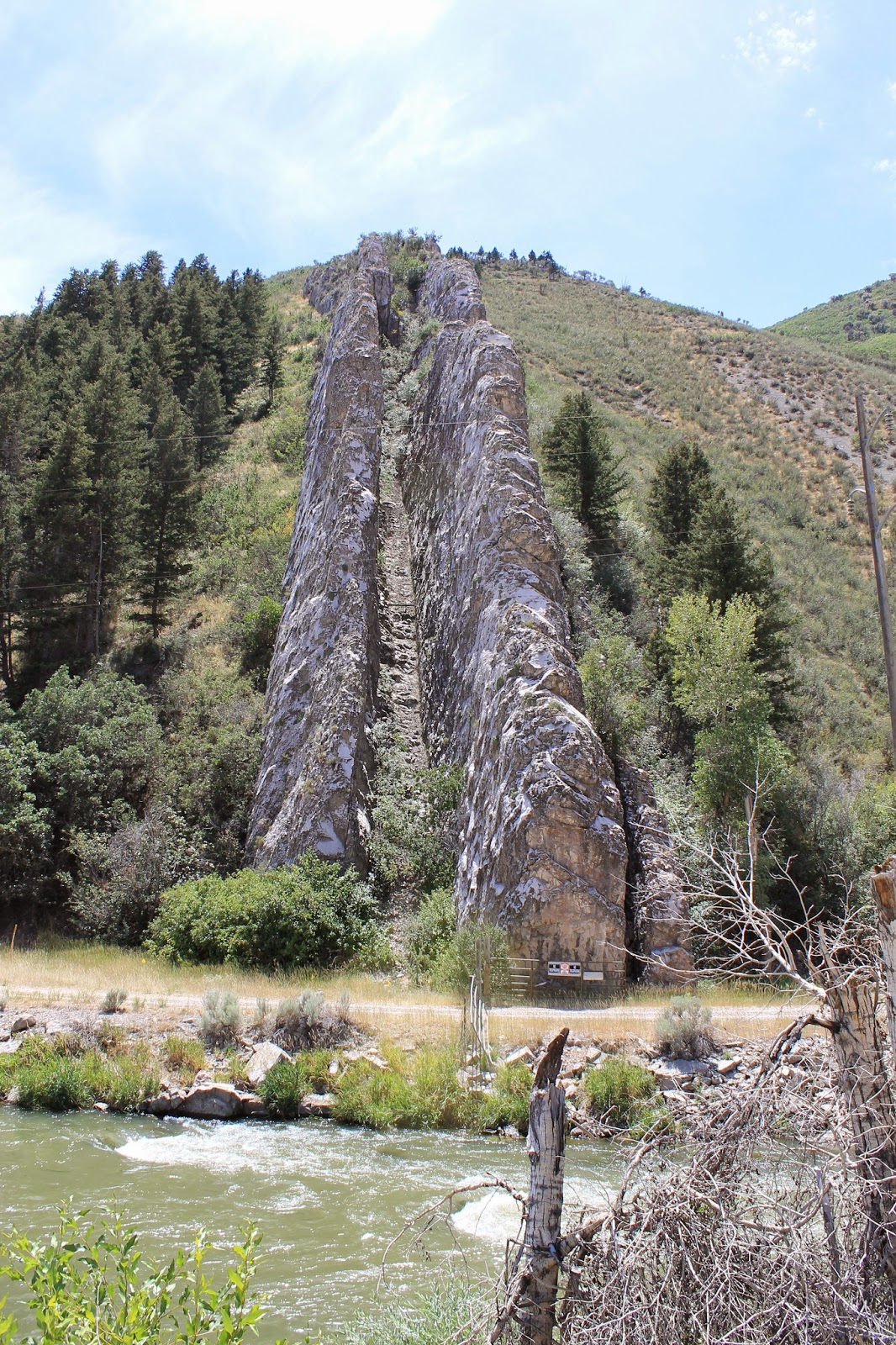 |
| Devil's Slide |
 |
| Yes, people were tubing down this river |
 |
| So.. I don't know why it's called Devil's Slide. The Devil's Alpine Slide? |
The
formation itself
was discovered by Aman Moore in 1904. The profit in natural cement led
to the creation of The Union Portland Cement Company to quarry the
limestone. Like many ghost towns in Utah, a company town was created.
The cement plant was successful and the little town in that narrow
canyon grew to 250 people! (Trust me, when you see it, that many
residents fitting beside that highway is impressive.)
The
town at its height had a two story hotel with a dining room that fed
many of the workers. Also there was a drug store combined with a post
office (
called the Red Devil Store I believe), there was a railroad depot, two schoolhouses (
with a harmonica band!)
and a company clubhouse. The company planted a hundred trees (which
frankly, is how we could tell where the town was. Look! Trees!), built a
baseball diamond and laid sidewalks (cement sidewalks of course! What a
perk!)
 |
| Two structures on a hill east of the garage (see garage below) |
 |
| Fell in love with this rustic look! |
 |
| We're on the shoulder of I-84 going west to see the remains of the town. |
The baseball team was called the Red Devil's. The town would basically empty when they had a game in Salt Lake or Davis County. "They received front page coverage on the sports pages of the newspapers,
and the team received special praise in the 1941 National Semi-Pro
Record Book."I love reading the
old newspapers and seeing the
little snippet of life.
Here's a story of one player who lost his leg at the cement plant in 1930.
This little town had a tragic story from
June 1910. Workers/residents were working in a one hundred-foot tunnel. Kegs of black powder were used for tunneling. These men sat cross-legged with their backs together, making a chain that went to the end of the tunnel. Once everyone was in this formation the powder kegs were handed to the front man at the mouth of the tunnel and he'd pass it over his head to the man behind him all the way to the end. Somewhere along this human chain a keg was dropped. The explosion was like a human shotgun, shooting men across the valley onto the surrounding hills. Seventeen men were killed. For such a small town, that must've been absolutely crushing! Most mine workers were foreign in those days. Seven Japanese, seven Austrians, two Italians and one Irishman were killed.
Most of the other foreigners left after that.
I spent a great deal of enjoyable time perusing through the
old newspapers and catching a glimpse of this town. If you haven't explored Digital Newspapers, you absolutely must!
H
ere's an add for the garage that's still standing. (With a three digit phone number! Yay for 1937!)
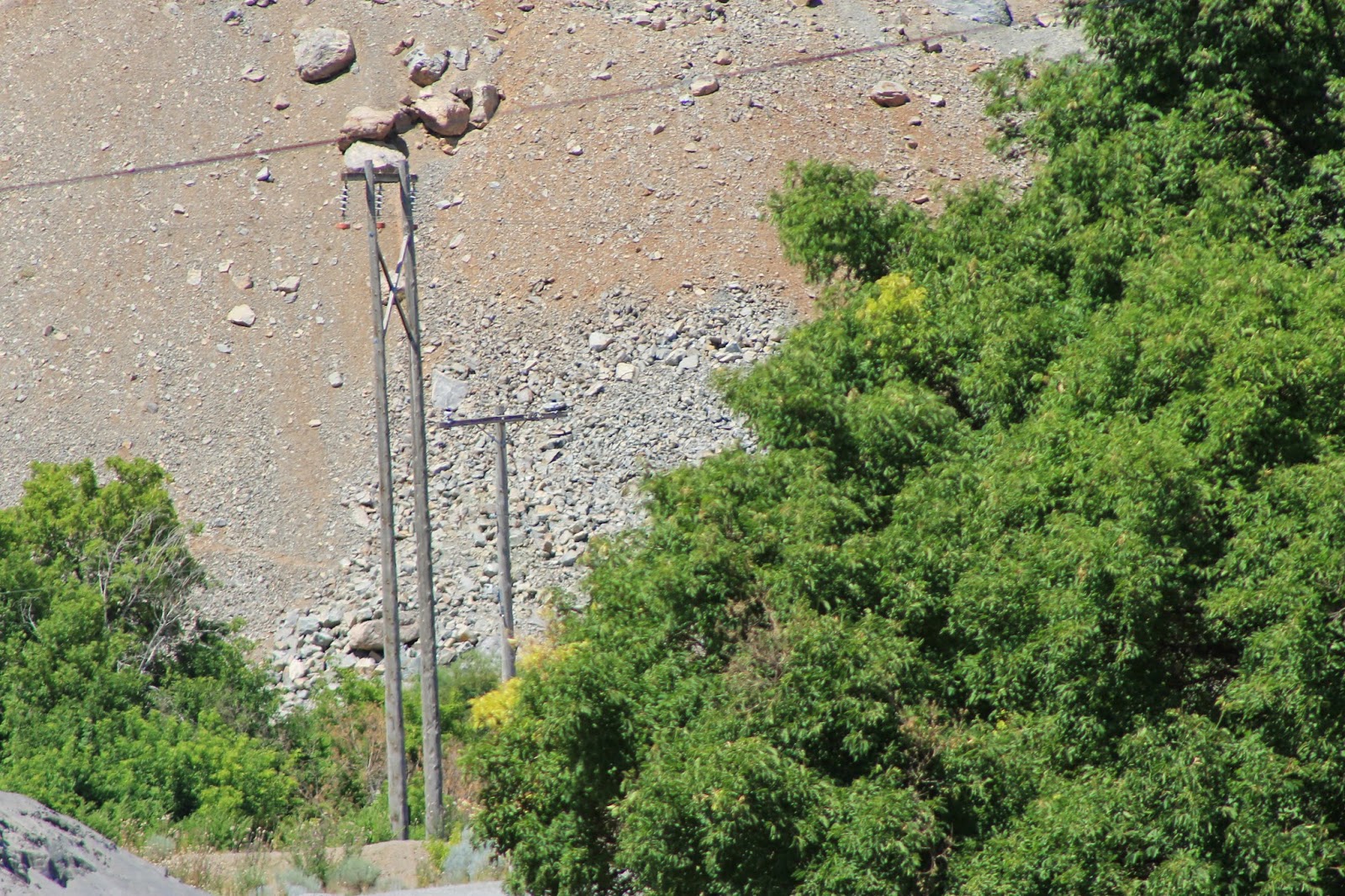 |
| Power pole with no power line |
As the years passed employees of the plant moved to near-by Henefer, Morgan and Croydon to live and commuted to work. It wasn't until the end of the 1980's that this little town really became a ghost. The company closed the village and the few remaining residents moved out. The last person to move out was the railroad section foreman. That house was demolished and the current gravel pit has buried most of what remained of the town except for the shadows of the past, and their names sake.
I think
this is the decision to have the little pull-out so cars can stop to see Devil's Slide. I wish we had the parking lot mentioned in this story.
 |
| The gravel pit that's buried most of the remains of the old town |
 |
| Devil's Slide formation on the way back to Ogden |
Bibliography:
http://www.morgannews.com/article/morgan-valley-memories-devil-slide-history-devil-slide
http://morgannewspaper.com/article/morgan-county-baseball-red-devil-devils-slide


 The train brought life to this town. There was a saloon (I read of 7 skeletons found when the saloon was excavated, but cannot find anything discovered regarding the cause of death, or where the remains were laid to rest), brothels, homes of adobe, school house, church, and railroad maintenance structures. There are many historical markers and stops up Echo Canyon, and a museum just a few miles up the road in Henefer.


